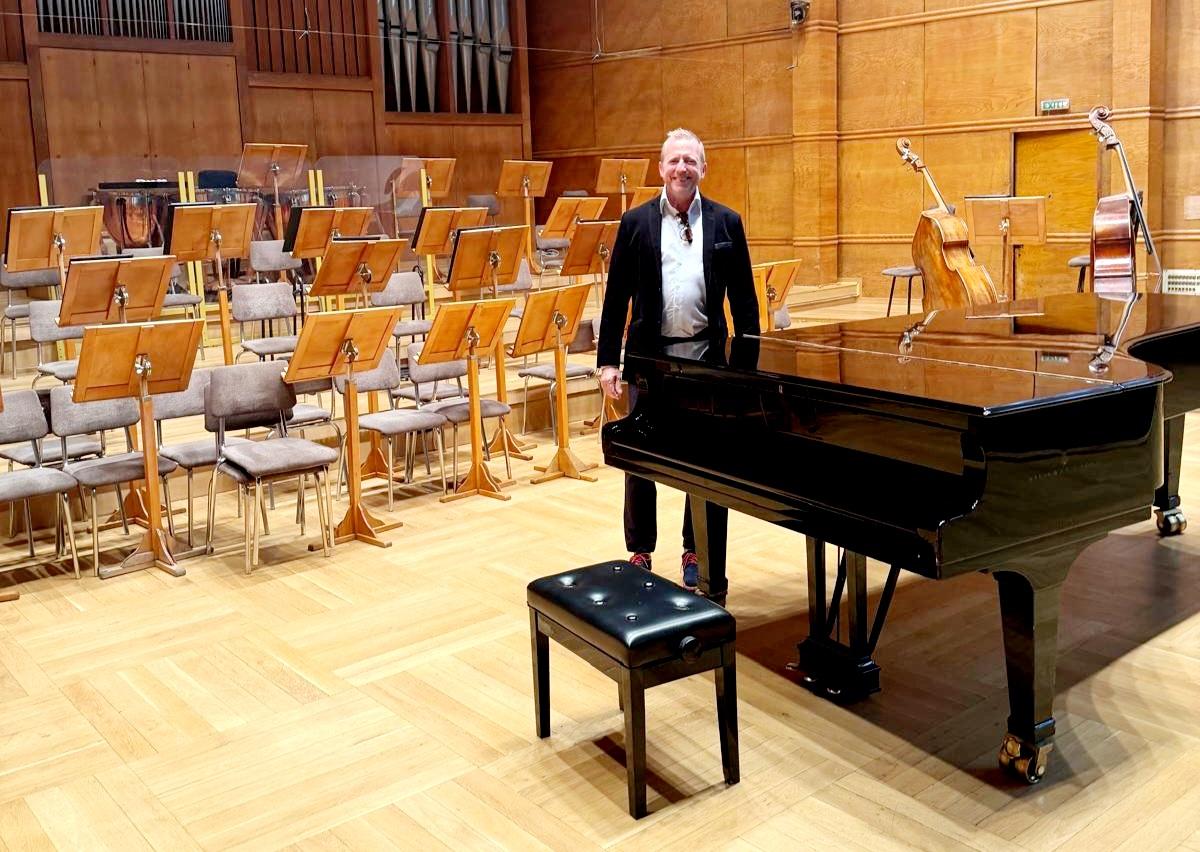
Last night, The Wonderful Wertheim Symphony had its world premiere at the Bulgaria Concert Hall in Sofia, performed by the Sofia Philharmonic Orchestra under Nayden Todorov. The applause lasted for minutes.
Few in the hall knew what they were watching. On the balcony, Carlos Guilliard, descendant of the forgotten industrial Wertheim dynasty, heard this musical monument to his own family for the first time.
The Wertheim name had not been spoken in public for the better part of a century. Last night, an orchestra spoke it for him.
Long after the heritage had seemingly been erased, Guilliard stepped into his forefathers' footsteps: generations who used culture to give back to society, and music to connect minds and cultures.
"Some stories end in silence. This one came back to life last night in Sofia and is to be continued."
MEDIA BACKGROUND
Concert Programme
The evening opened with Gwilym Simcock's Concerto for Soprano Saxophone, Horn and Violoncello, performed by internationally acclaimed soloists Jess Gillam, Ben Goldscheider and Sheku Kanneh-Mason.
The second half of the programme presented the world premiere of The Wonderful Wertheim Symphony by Roland Baumgartner, commissioned by Carlos Guilliard and his long-time team.
About the Symphony
Inspired by the history of the Wertheim family, the symphony explores universal themes of innovation, family, resilience, displacement and legacy. Rather than recounting historical events chronologically, it reflects on the lasting human impact of one family's contribution to European society.
About the Composer
Roland Baumgartner is an internationally recognised composer whose work spans orchestral, chamber and vocal repertoire. The Wonderful Wertheim Symphony is the result of several years of research and collaboration surrounding the rediscovery of the Wertheim family's history.
About the Wertheim Family
Joseph Wertheim founded his sewing machine business in Frankfurt in the early 1860s, with a sales branch in Barcelona (1870), following his return from the United States. With remarkable foresight, his son Karl founded Rapida S.A. in Barcelona in 1920 under the name Don Carlos Vallin Ballin, carrying the family's industrial legacy into Spain.
This took place at a time when the first anti-Semitic movements were becoming active in Germany — movements that culminated in 1932 in the closure of the 600-strong factory in Frankfurt and ultimately in the expropriation of the family. Like so many Jewish families of that era, the Wertheim family too fell victim to the persecution of Jews: in 1938, Karl Wertheim's brother Paul — formerly head of the Frankfurt factory — took his own life under the weight of the closure and expropriation; in 1941, his brother Franz was murdered by the Nazis; and Karl Wertheim's nieces, including Ilse Minna Rosalie Hesselberger (née Wertheim), were arrested between 1941 and 1944 and perished in one of the many concentration camps.
Other family members succeeded in escaping to Australia. Although the family name gradually faded from public consciousness, its contribution to European industrial and social history continues to resonate to this day.